
The AI SaaS Revolution: How Entrepreneurs Are Building Smarter, Faster, and Leaner Startups.
Discover how AI-powered SaaS startups are reshaping entrepreneurship in 2026. Learn how founders are shipping MVPs in days, building LLM-powered products, and scaling lean teams with intelligent automation.
The rules of building a startup have changed completely. What once required a six-figure budget, a full engineering team, and a 12-month development roadmap can now be accomplished by a solo founder with a laptop, an internet connection, and the right AI tools, in under two weeks.
We are living through the AI SaaS revolution, and the entrepreneurs who understand what is truly happening are not just moving faster. They are building in fundamentally different ways.
This insight explores how AI is reshaping the startup lifecycle, from ideation to MVP, from product development to growth, and why the competitive edge in 2026 is no longer about who has the biggest team or the deepest pockets.
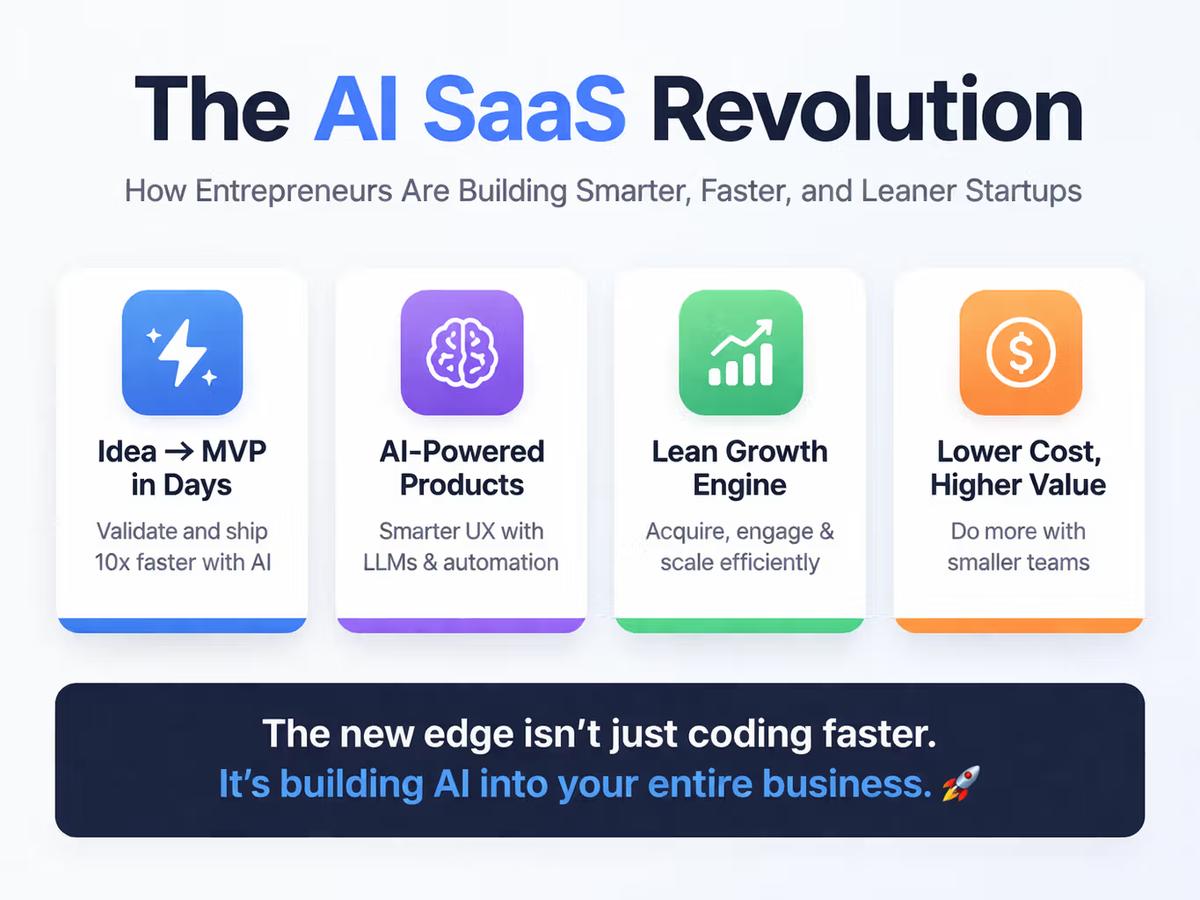
From Idea to MVP in Days, Not Months
One of the most dramatic shifts in modern entrepreneurship is the compression of the validation cycle. The traditional path from idea to working product was painfully linear: market research, wireframing, hiring, building, testing, iterating. Each step added weeks or months and significant financial risk.
AI tools have collapsed this timeline. Founders today are using platforms like Cursor for AI-assisted code generation, Claude and GPT-4 for product logic and user flow design, and no-code platforms like Framer and Bubble to handle the frontend, all within days of having an idea.
"The question is no longer 'can we build this?' It is 'how fast can we learn if this is worth building?'"
This speed-to-validation is the new startup superpower. By shipping a lean MVP in days, founders can gather real user feedback before spending significant resources, reducing the risk of building something the market does not actually want.
The founders winning in 2026 are not the most technically skilled. They are the ones who have learned to use AI as a force multiplier, validating 10 ideas in the time it used to take to validate one.
AI-Powered Products: Smarter UX Through LLMs and Automation
Beyond development speed, artificial intelligence is changing what the products themselves can do. Large Language Models, LLMs, have introduced a new category of product experience that was simply not possible three years ago.
Modern SaaS products are integrating AI not as a feature, but as a core part of the user experience. Customer support that resolves queries without human agents. Personalised onboarding flows that adapt to each user's behaviour. Intelligent dashboards that surface insights before users even know to look for them.
This shift from static software to adaptive, intelligent products is widening the gap between AI-native startups and legacy software companies. The UX expectations of users are evolving rapidly, and businesses that fail to integrate intelligence into their product layer are already falling behind.
For entrepreneurs, the opportunity is clear. Building with LLMs, automation workflows, and AI-native UX patterns is no longer reserved for well-funded deep-tech companies. It is accessible to any founder willing to learn the new tools.
The Lean Growth Engine: Acquire, Engage, and Scale Efficiently
Growth has always been the hardest part of building a SaaS business. Customer acquisition is expensive. Churn is relentless. Retention requires constant product attention. Traditionally, scaling required adding people — more salespeople, more marketers, more support staff.
AI is turning this model on its head. The lean growth engine of 2026 looks very different from the growth playbooks of five years ago.
AI-Driven Customer Acquisition
Founders are using AI tools to generate SEO content at scale, run personalised ad campaigns, and identify high-intent prospects through data enrichment. What once required an entire marketing team can now be orchestrated by a single growth-focused founder using intelligent automation.
Automated Engagement and Retention
Behavioural triggers, AI-generated email sequences, intelligent chatbots, and predictive churn models are enabling SaaS companies to engage users at exactly the right moment with exactly the right message — without a large team manually managing each touchpoint.
Scalable Systems Over Headcount
The lean growth mindset is not about doing less. It is about building systems that scale without linear cost increases. Every manual process that gets automated becomes a competitive advantage — because it compounds over time while the cost remains flat.
Lower Cost, Higher Value: Doing More With Smaller Teams
The economics of SaaS have fundamentally shifted. A decade ago, a SaaS startup targeting $1M ARR might have needed 15 to 20 people to get there. Today, that same milestone is being reached by teams of two or three, sometimes by solo founders.
This is not because the work has become easier. It is because AI tools are effectively acting as silent team members, handling customer queries, generating content, writing code, analysing data, managing workflows, for a fraction of the cost of a full-time hire.
The implications for startup economics are significant. Lower burn rates mean longer runways. Longer runways mean more time to find product-market fit. And leaner cap tables mean founders retain more ownership of the value they create.
The new edge is not just coding faster. It is building AI into every layer of your business.
What This Means for Entrepreneurs in 2026
The AI SaaS revolution is not a future trend. It is happening right now, and the window of asymmetric opportunity is open, but it will not stay open indefinitely.
The entrepreneurs who will look back on this period with satisfaction are the ones who stopped waiting for the perfect idea, the perfect team, or the perfect moment. They started building. They used every AI tool available to validate faster, build smarter, and grow leaner.
The ones who will look back with regret are the ones who saw the wave coming and waited on the shore.
Final Thought
At Realm by Rook, we work at the intersection of intelligent systems and brand architecture. The AI SaaS revolution is not just changing how products are built, it is changing the entire operating model of a business. From the way founders think to the way companies are structured to the way value is created and delivered.
The question for every entrepreneur reading this is simple: Are you still building like it is 2019?
Because the market has moved on. And so should you.
Stay Updated with Our Latest Insights
Subscribe to our newsletter to get notified when we publish new content on design, development, and digital strategy.